A platform can handle scheduling, data, payments, approvals, and automation, yet leave a buyer unsure what they should purchase it for. Explaining more features rarely settles that uncertainty.
The buyer is working through a decision: whether a problem deserves investment, which approach fits, what must change, and whether the expected benefit justifies the effort.
I start by examining the relationship between that decision and the actual offer. What can the business reliably deliver? Which customers have a reason to prefer it? Can we acquire and serve them on sustainable terms?
Those questions matter because an apparent messaging problem can originate in product boundaries, packaging, customer selection, or delivery. Positioning becomes more useful when it helps the business recognize the difference.
The framework below connects those choices. It gives marketers a way to develop the buying case, coordinate proof, and learn from commercial outcomes.

Establish what you are positioning
Before interpreting demand, document the offer. Identify the customer job, product category, included capabilities, dependencies, deployment method, and revenue model. Distinguish the standard product from customer-specific work and future development.
A platform built around one large customer's requirements may contain valuable capabilities. The question is which can be repeatedly sold and supported across the intended segment. A narrow segment can be a good market; recurring bespoke obligations need a different commercial assessment. Check three forms of repeatability: whether the technology works across suitable environments, whether teams can deploy and support it consistently, and whether acquisition and service costs leave a viable return. Marketing needs validated answers from the teams responsible for each.
Watch for a prominent feature overshadowing the broader buying case. An identity capability can make an operational platform appear to belong to a security category. A kiosk-first presentation can emphasize hardware while obscuring the workflow improvement.
Shared technology does not automatically mean a shared reason to buy. Offers with different buyers, contracts, or success measures may need distinct routes within the same brand.
Then map alternatives: direct vendors, adjacent tools, internal development, and the existing process. Separately identify search competitors, which may include publishers and directories. Winning attention and displacing a commercial alternative are different challenges. 1
Use evidence to choose who to pursue
External research, competitive offers, customer conversations, and account intelligence help form an initial market hypothesis. Your own search and website data can refine it as visibility develops. Those queries also reflect the content you already publish and can rank for; they do not reveal the whole market.
Read queries for meaning. A product-category search may indicate exploration without revealing the underlying problem or purchase readiness. A branded query may refer to a similarly named organization. A comparison query suggests alternatives under consideration. None automatically identifies a decision-maker or willingness to pay. Search helps establish language and category interest. Evidence of preference comes from the alternatives suitable buyers actually shortlist, choose, renew, or reject. Corroborate account intent through conversations and recorded decisions.
Use competitor visibility and engagement estimates to identify questions worth investigating, rather than treating them as direct evidence of sales success. Semrush, for example, models competitor traffic from external data rather than accessing the site's internal analytics. 2
Keep customer fit, adoption readiness, product maturity, and category hype separate. Fit concerns the job and constraints you can serve. Readiness concerns the buyer's ability and willingness to change. Product maturity concerns what you can reliably deliver today. Rogers' adopter categories concern relative adoption timing; company size alone does not establish a customer's category. 3 Technology hype describes market expectations, not an account's deployment readiness. 4 A legacy brand may carry reassurance; a newer entrant may offer an attractive advance. Establish which trade-off the segment values instead of assuming novelty or familiarity will win.
Use market sizing to bound that choice. TAM describes the total potential demand; SAM narrows it to what your offer and operating model can serve; SOM estimates what you can realistically capture within a stated period, given competition and resources. A high-need segment still needs a credible route to acquisition and delivery. Early adopters are not automatically your obtainable market.
Choose a buying case with viable economics
The primary buying case explains why this customer should make this change now. Look for a consequential problem, an owner, a trigger, and an advantage over the approach they could reasonably choose instead.
The lead argument depends on that context. A buyer with an acknowledged operational problem needs a credible improvement. A buyer comparing familiar vendors needs a relevant difference. A buyer encountering an unfamiliar approach needs a clear job, category, and evaluation path. Expansion, contract renewal, a growing backlog, a regulatory deadline, or a required system change can create timing; confirm the actual trigger with the buyer.
Separate switching architecture from switching economics. Replacement, integration, and phased adoption describe how change happens. Their economics include what the transition costs, when benefits begin, and what ongoing obligations remain. An integration can preserve an existing system while still creating substantial implementation and support work.
Distinguish the buyer's economics from your own. The buyer assesses benefits against implementation, migration, training, operating costs, and disruption. Your business assesses acquisition effort, deployment cost, support requirements, contribution, and retention. Gross-margin-adjusted acquisition payback helps keep revenue and economic recovery distinct. 5 At segment level, ask whether enough suitable, reachable accounts justify continued development and go-to-market investment.
I would prioritize repeatable deployments while selectively considering larger accounts whose requirements could produce reusable capabilities. The allocation depends on cash timing, capacity, and strategic fit. Customization becomes attractive when its benefits extend beyond the original contract. A large deployment provides useful learning, but size alone does not prove scalability.
I would defer either segment, or both, if the required scope is unsupported, service costs undermine the return, cash recovery exceeds what the business can sustain, or delivery would displace more valuable commitments. Put a boundary on engineering and implementation capacity before pursuing both motions.
Price can lead when buyers see genuine parity and the economics support that choice. First investigate whether implementation effort, reliability, control, or support creates a meaningful difference. More features and a lower price are not automatic reasons to switch.
Build a hierarchy buyers can follow
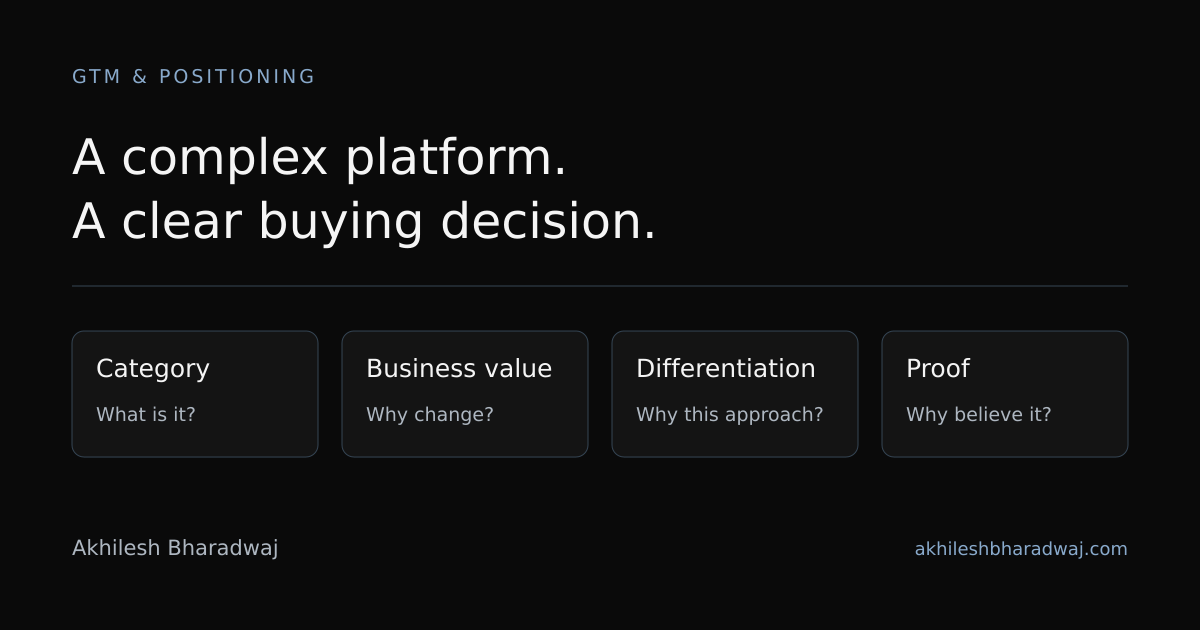
Organize the proposition into four layers: category, business value, differentiation, and proof. The category establishes the comparison. The value explains why the outcome matters. Differentiation explains why this approach deserves consideration. Proof reduces the uncertainties preventing a decision.
A feature-first description might say, "A platform combining workflow automation, integrations, and analytics." A more useful buying case might be, "Move purchase requests to a decision faster, with clear approval rules and a traceable record."
The second statement gives the capabilities a job. It still needs evidence and a credible explanation of why the approach is preferable to the buyer's alternatives.
Document the core job and expected standard first. Augmented capabilities deserve prominence when they influence choice; a feature being additional does not make it differentiating. Keep potential capabilities on the roadmap separate from the supported offer. A future capability can inform development without becoming a current buying benefit.

Give the buying committee one case and different proof
Keep the product scope and core buying case consistent. Adapt emphasis, evidence, and success criteria to each stakeholder. Some criteria are KPIs; others are conditions the purchase must satisfy. Stakeholder KPIs can differ inside the same organization even while the central proposition stays consistent.
Confirm who sponsors, funds, influences, and can block the purchase. Job titles alone do not establish the decision process.
Consider the purchasing example. Operations asks for automated approvals; IT wants managers to retain control. Sales should clarify whether operations means automating routing and reminders or delegating the approval decision itself. Product confirms what is supported. Marketing then explains the shared outcome accurately.
If there is a genuine capability gap, broader demand and commercial potential can inform a product decision. Persuasive wording cannot resolve an unsupported requirement.
| Stakeholder | Decision to support | Useful proof |
|---|---|---|
| Operations | Will the workflow improve? | Demonstration, cycle time, rework, manual follow-ups |
| IT | Can we deploy and support it appropriately? | Integration validation, permissions, dependencies, ownership |
| Finance | Does the investment make economic sense? | Full costs, credible benefits, payback assumptions |
| Security and risk | Can we approve the exposure? | Controls, audit evidence, resilience, compliance validation |
| End users | Will this improve the work? | Usability testing, workflow fit, exception handling |
| Procurement | Are the terms and obligations acceptable? | Contract scope, vendor evidence, service responsibilities |
Carry the proposition through the buying journey
The homepage should establish the category, central buying case, and appropriate route. Solution pages should connect that case to a buyer's situation. Product pages should explain the mechanisms, dependencies, and supported scope.
Sales materials should help the buying group compare alternatives and evaluate implementation. A proof of value should have agreed success criteria before the evaluation begins.
The proposition also needs a delivery check. Sketch the customer's actions, visible interactions, backstage work, and supporting systems for one representative workflow. This service-blueprinting approach exposes dependencies behind the promise. 6
A subscription that consolidates tools becomes valuable when the resulting workflow removes a meaningful burden. Check what staff still need to re-enter, coordinate, approve, or resolve. Released time creates capacity; it becomes a cash saving when expenditure actually falls.
This exercise helps marketing ask the right questions of product, implementation, and customer success before scaling the claim.
Use sales feedback to correct expectations
Marketing should equip sales to capture the expected outcome, the buyer's wording, where the expectation reportedly came from, and its effect on the purchase.
Marketing then examines the relevant campaign, page, presentation, referral, or partner material. Product validates the actual scope. Partner owners address inaccurate descriptions within relationships they manage.
A form can identify the submission page. Attribution assigns credit among observed interactions; it does not explain what the buyer believed. 7 Ask about the perceived promise before deciding which material caused the gap.
Repeated misunderstanding can indicate unclear framing even when individual statements are technically accurate. Interpretation is part of the message's performance, not simply the buyer's responsibility. A single serious mismatch can warrant immediate investigation. Prioritize according to the buying consequence and the strength of the evidence.
Correct the responsible source, update the sales guidance, and examine whether later conversations reveal the same problem. If buyers understand the offer accurately but need something different, investigate targeting or product suitability. When fit and implementation are sound, inspect whether packaging forces an unwanted commitment, price exceeds justified value, or timing lacks a real trigger before changing the headline or discounting.
Validate through qualified commercial progress
Before rollout, ask representative target buyers to explain the offer, its relevant difference, and the evidence they would require. During rollout, examine commercial progression alongside those comprehension signals.
Track sales-accepted opportunities, qualified pipeline, recurring objections, evaluation progress, win/loss reasons, and sales-cycle movement. Follow through to activated revenue, retention, and expansion where the purchase makes those outcomes relevant.
Use explicit definitions for deal value, ARR, recognized revenue, and collections. Preserve marketing-sourced and marketing-influenced contribution under stated rules without adding overlapping totals together.
Set a baseline and a review period appropriate to the buying cycle. Compare similar cohorts and annotate changes in channels, pricing, sales coverage, and product delivery. Improved results justify investigation; they do not isolate positioning as the cause.
If understanding improves but technical evaluations stall, inspect feasibility. If relevant buyers understand the value yet see no urgency, revisit the trigger. If sales repeatedly encounters a different requirement, review the target and buying case.
A working positioning brief
Complete these six lines before commissioning another campaign:
- Offer and boundary: What is sold, supported, integrated, and separately scoped?
- Target and trigger: Who has the need, authority, and reason to act?
- Alternative: What would they do if this offer were unavailable?
- Buying case: What improvement justifies the change, and why this approach?
- Proof: What must each stakeholder establish, and who supplies the evidence?
- Validation: Which commercial signals, baseline, review period, and revision conditions will we use?
Test whether a buyer can use the brief to explain the recommendation internally. That is a useful standard for deciding whether the positioning is ready to travel through a website, partner conversation, campaign, or sales process.
If your platform has several credible stories, the next decision is which one deserves to lead. Discuss your platform's positioning.
Sources and further reading
- April Dunford, The No Differentiation Illusion ↗
Competitive alternatives and customer-relevant differentiation.
- Semrush, Traffic Analytics methodology ↗
Source and estimation limits of competitor traffic data.
- Everett M. Rogers, Diffusion of Innovations ↗
Adoption categories and relative adoption timing.
- Gartner, Hype Cycle methodology ↗
Technology expectations, maturity, and adoption context.
- Bessemer Venture Partners, Scaling to 100 Million ↗
Gross-margin-adjusted SaaS economics.
- Sarah Gibbons, Service Blueprints Definition, Nielsen Norman Group ↗
Mapping visible and supporting delivery processes.
- Google Analytics, Get started with attribution ↗
Attribution as the allocation of credit to interactions.
Written by Akhilesh Bharadwaj, a marketing, GTM and commercialization leader who writes about the decisions behind growth, customer trust, product adoption and business performance. Connect on LinkedIn.